How the Beef Checkoff is Teaching Students that Cattle are Destroying the Climate
“Saying cattle are bad for the environment is like saying that fish are bad for the ocean.”
By Jim Mundorf
No one has been a harsher critic of agricultures involvement in the climate change lies, than myself. While at the same time I have also been one of the loudest critics of the program that forces all cattle producers to pay at least one dollar per head of cattle, every time cattle are sold. That program is the Beef Checkoff. I have put countless hours into exposing the truth about these issues over the years. A little over a year ago I gave a speech about the beef checkoff. In it I talked about how my daughter was taught in school that cattle are bad for the environment. I used that example to show where the checkoff should be focusing their efforts instead of doing things like sponsoring Nascar races. Unfortunately the Beef Checkoff is doing just that. They are focusing their efforts in schools in a way that blatantly undermines every single cattle producer that has ever paid a dollar into this program.
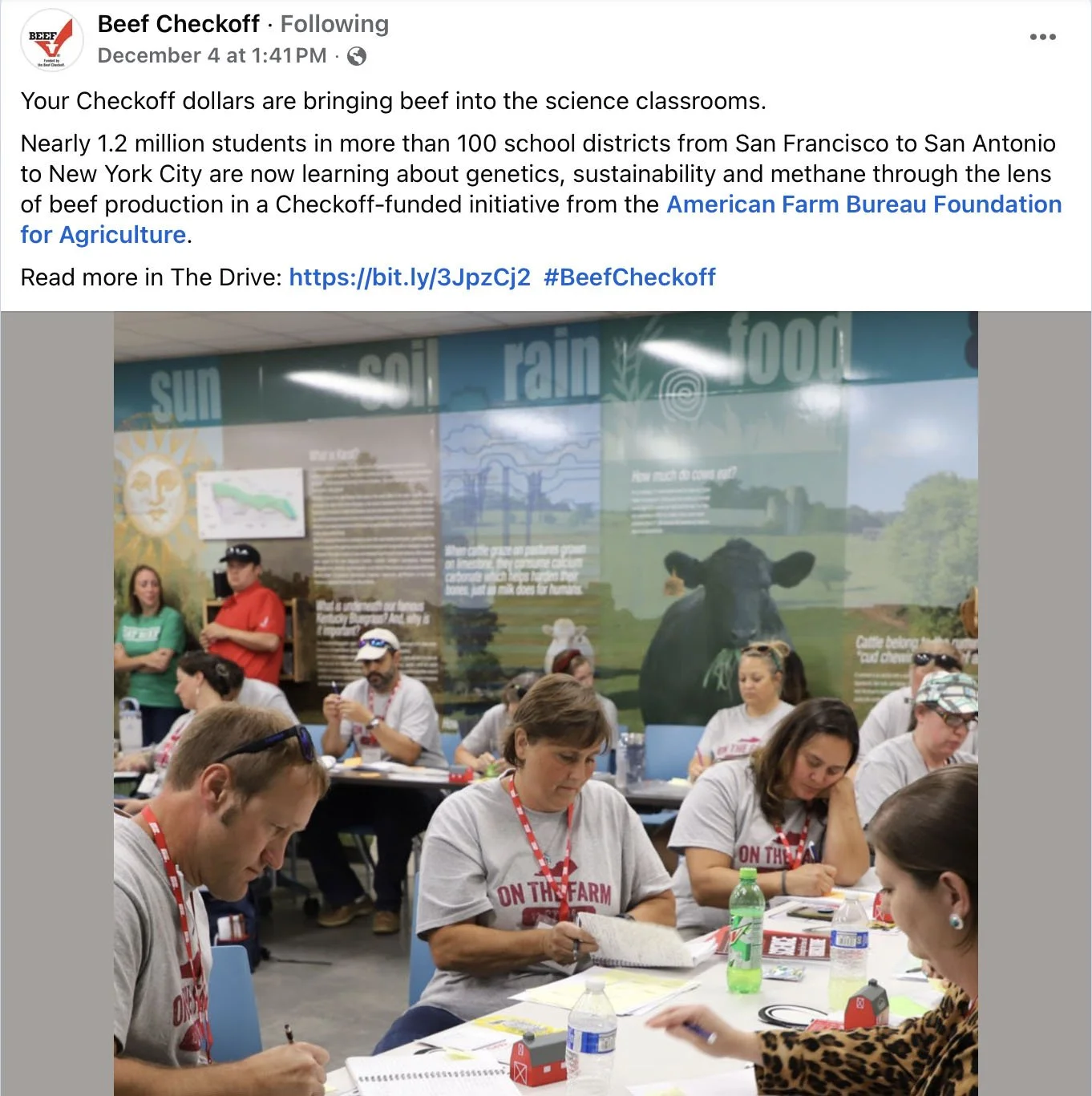
On December 4 the Beef Checkoff posted this on Facebook:
After scrolling through a number of lessons I thought this looked like a good program, similar to what I was hoping to see, that is until I found one that related to cattle and climate change. It was called, Methane and Cattle: A Climate Connection. From the title you might think that this lesson blames cattle for climate change, which it definitely does, but if you dig into the lesson, what you will find is that the actual end goal is for students to be able to teach farmers and ranchers how their cattle are causing climate change, and how they need to change their practices.
The lesson focuses on methane. A naturally occurring gas that comes from naturally occurring animals, ruminants that eat grass. Cattle are the largest population of ruminants because they are the most efficient ones for us to eat. Therefore they are the largest producer of methane. What the lesson doesn’t explain is that if all cattle were wiped off the face of the earth, the grass they eat would eventually be eaten by other ruminants, like buffalo, elk, moose, or deer and then those animals would become the largest producers of methane. Blaming cattle for climate change is no different than blaming volcanos, or the oceans, or lightning strikes that cause wildfires.
The reason the Beef Checkoff wants to connect cattle to climate change is because cattle producers own cattle, and the corporate interests that control the Beef Checkoff want to control and profit off of cattle producers. So they created the task Methane and Cattle: A Climate Connection, to be completed by, “young skulls full of mush,” so that they could create the kind of customers that the corporate controlled beef industry wants. Ones that will tell farmers and ranchers how they should do their jobs.
The following information was taken from Methane & Cattle: A Climate Connection Teacher Guide
Lesson 1
In these lessons students are to assist the fictitious Dr. Williams who, “is a climate scientist studying methane emissions from cattle.” The first lesson teaches students how cattle’s stomachs create methane. It has one sole purpose, which is to show how harmful methane is to the climate. The first assignment has students explain how methane is created and released from cattle. The second assignment of this lesson has students, “Describe how methane impacts the environment after it is released into the atmosphere.” To help students describe this they are to use this graph that shows methane having 84 times the amount of Global Warming Potential as carbon in the first 20 years.
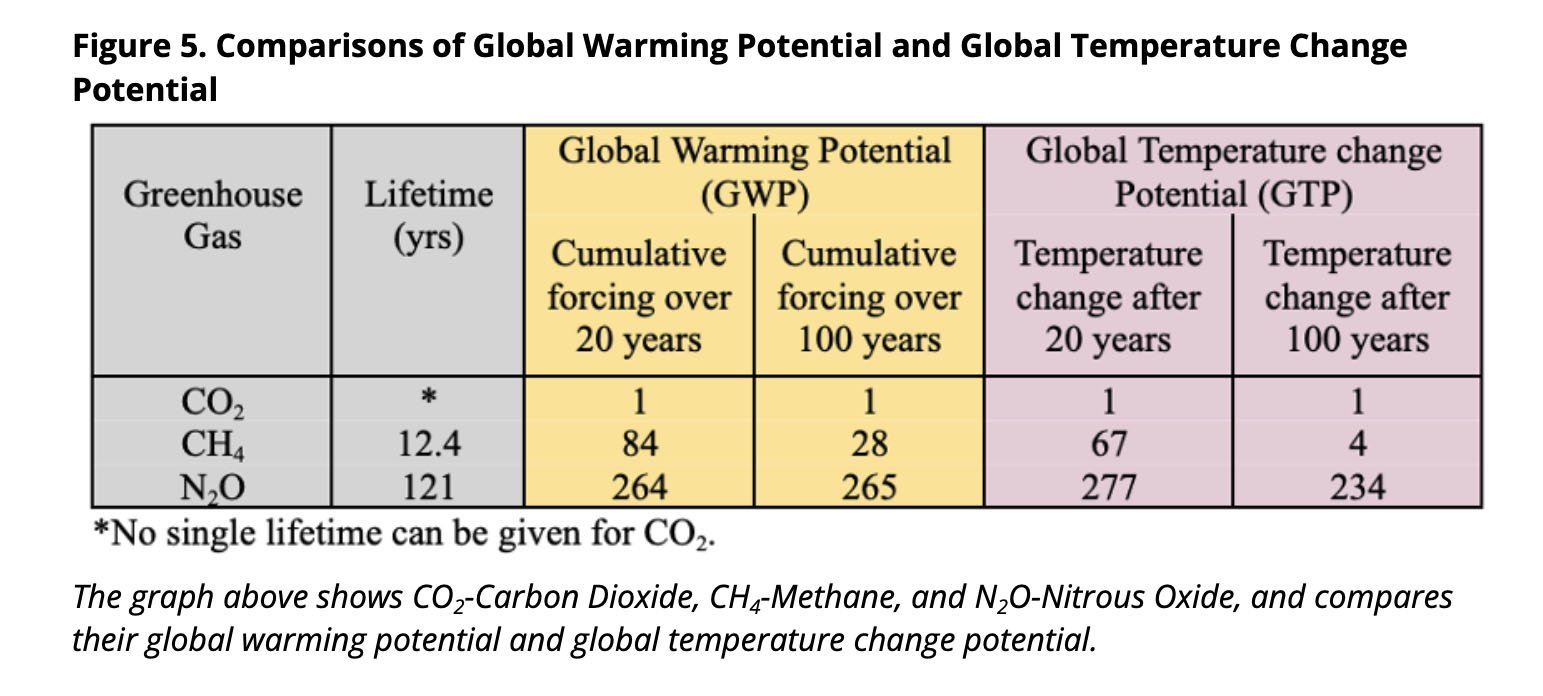
The teaching guide gives an example of what a proficient answer would look like from this assignment. Here are a few quotes from a proficient answer: “Methane impacts the environment by trapping heat in the atmosphere…When comparing methane to carbon dioxide, Figure 5 shows that methane has a much stronger impact over shorter time periods…The evidence from Figure 5 also shows that methane causes more temperature change in the short term.”
Lesson 2
Once students understand how cattle create methane, and how damaging methane is to the climate, they move on to Prompt 2 where, “Dr. Williams wants to create a clear and easy-to-understand visual that she can share with people. The goal is to explain how methane is produced in cattle and its connection to broader environmental systems. She’s asked you to help her design a model that’s scientifically accurate but also simple enough for people without a science background to understand.” So, Dr. Williams needs the students to help her show how damaging cattle are to the climate, to people who aren’t familiar with how damaging cattle are to the climate, AKA farmers and ranchers. The first assignment that goes with this lesson is for students to create a visual model that starts with, “A cow eating plant material” and ends with, “Methane entering the atmosphere and trapping heat.”
Once students have their cattle emission model drawn out they move on to the second assignment where, “Dr. Williams now needs help explaining the model to a group of farmers and ranchers and wants to make sure it connects to what they already care about: healthy cattle, good feed, and protecting the land.” Remember in the beginning of the lesson where this was said to need to be, “simple enough for people without a science background to understand.” Turns out those people without a science background, that need this whole methane explanation to be dumbed down for them, so that they can understand how damaging cattle are to the climate, are farmers and ranchers. Ironically, the very same farmers and ranchers that are forced to provide the funding that pays for this very lesson. Infuriating.
The assignment: Write a short explanation that Dr. Williams could use when talking to ranchers. In your explanation, be sure to:
Describe how energy moves from plants to cows to methane to the atmosphere
Explain how matter (carbon, hydrogen, etc.) is transformed during digestion
Connect the methane released by cattle to its effects on the atmosphere
Use simple, clear language that would make sense to someone new to this topic
Lesson 3
Prompt 3 is simply more of the same: “Dr. Williams wants to put together a demonstration to show how methane is created during digestion in cattle. She’s asked for your help in designing an investigation that models this process.”
The assignment: “Explain how your investigation explains the biological processes of methane digestion in cattle and the impacts it has on the global-scale atmosphere.”
Lesson 4
Now that students are able to explain to farmers and ranchers how detrimental their animals are to the climate there is only one thing left to do, tell farmers and ranchers how they need to change their operations.
Help Dr. Williams prepare by writing a clear explanation that shows how cattle digestion connects to climate change.
In your explanation, be sure to:
Trace the movement of energy and matter from plant consumption through microbial digestion and into the atmosphere.
Use your model from Prompt 2 and your investigation from Prompt 3 as examples or evidence.
Explain how methane affects Earth’s climate compared to other greenhouse gases.
Suggest at least one possible solution or change that could reduce methane from cattle.
Their example of a proficient answer contains the following: “Once methane enters the atmosphere, it acts like a heat-trapping blanket. It absorbs heat energy that the Earth is trying to release and sends some of that heat back down. Even though methane doesn’t last as long in the atmosphere as carbon dioxide, it’s much more powerful in the short term. This means reducing methane now could make a big difference quickly.
One possible solution is to adjust cattle feed. Some feed additives or higher-quality forages can help reduce the amount of methane that microbes produce without harming the cow’s digestion. Other approaches, like breeding for low-emission animals or improving manure management, could also help.”
Money and Control
The Beef Checkoff has been controlled by corporate interests for a long time. The climate change agenda has been pushed into agriculture through those same corporate interests. The fraudulent climate change agenda for agriculture has two main goals. 1. Remove all independence by controling every aspect of farmers and ranchers operations. 2. Make money.
Right now, in Denmark it has been mandated that all farms with over 50 cows feed an additive to reduce methane to their dairy rations for at least 80 days per year. There have been 100s of complaints of health issues and deaths in cattle due to this additive. Right now, the corporate cattle industry has the pedal to the metal pushing a genetic line that will lower emissions. Just today in Beef Magazine, an article came out pushing the use and verification of low emission genetics. American Angus Association has accepted $4.85 million dollars from the Bezo’s Earth Fund to “to integrate low-methane traits into beef cattle breeding programs.” There has never been a harder push to change the way cattle are produced than right now, and it all comes down to money and control. What that proves is that this lesson was not a mistake. This is not something that the leadership at Farm Bureau or the Beef Checkoff passed off to someone else to create. The lessons taught here are to create the kind of customers that the corporate controlled beef industry wants. Customers that will tell farmers and ranchers how they should do their jobs, in the name of climate change.
Tear It Down
This is one of the most infuriating things I have laid eyes on. The real lesson that should be learned from this is that the Beef Checkoff is controlled by the wrong people. The corruption that would allow something like this to happen is much too deep to weed out. The Beef Checkoff needs to be completely dismantled and rebuilt by people who want what’s best for cattlemen and women. People who understand that the greatest marketing tool this industry has is promoting the freedom, independence and rugged individualism that this industry and country has thrived on. Making that happen is not going to be easy, but it should start with making sure everyone who has ever paid a dollar into this program sees what the people in charge have turned it into. It should start with sharing this article.
Follow Lonesome Lands

Jim Mundorf is the owner of Lonesome Lands and The Drover House. He also works on his family’s farm in Southwest Iowa.
Design based off of the Erwin E. Smith photograph of a cowboy on a ridge in west Texas. This design was hand drawn by artist, Nick Stroia. Color is Midnight Navy. Shipping is free.

Lonesome Lands logo as drawn by Artist Nick Stroia. Color is a dark gray heather. Shipping is free.